Otxarkoaga aims to become an eco-neighbourhood with the setting up of an Energy Self-consumption Association

Otxarkoaga aims to become an eco-neighbourhood with the setting up of an Energy Self-consumption Association

  • Shared self-consumption will enable the sharing of surplus energy generated by the solar panels of the F Shopping Centre and one of the five blocks of buildings being refurbished in Txotena Street.
  • The initiative of Bilbao Municipal Housing together with residents of the Bilbao neighbourhood is part of the Orain Otxar building renovation and urban regeneration project.

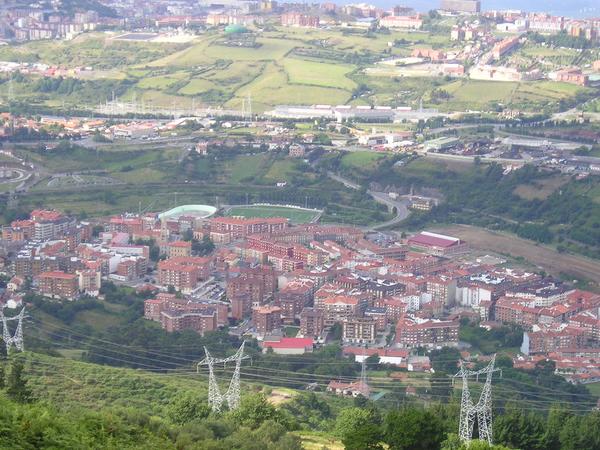
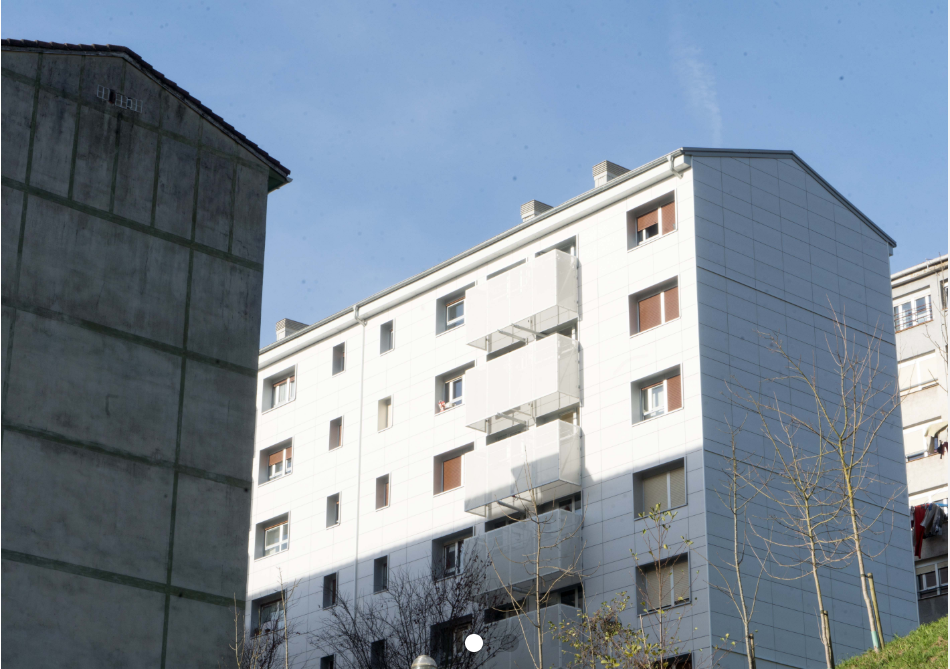
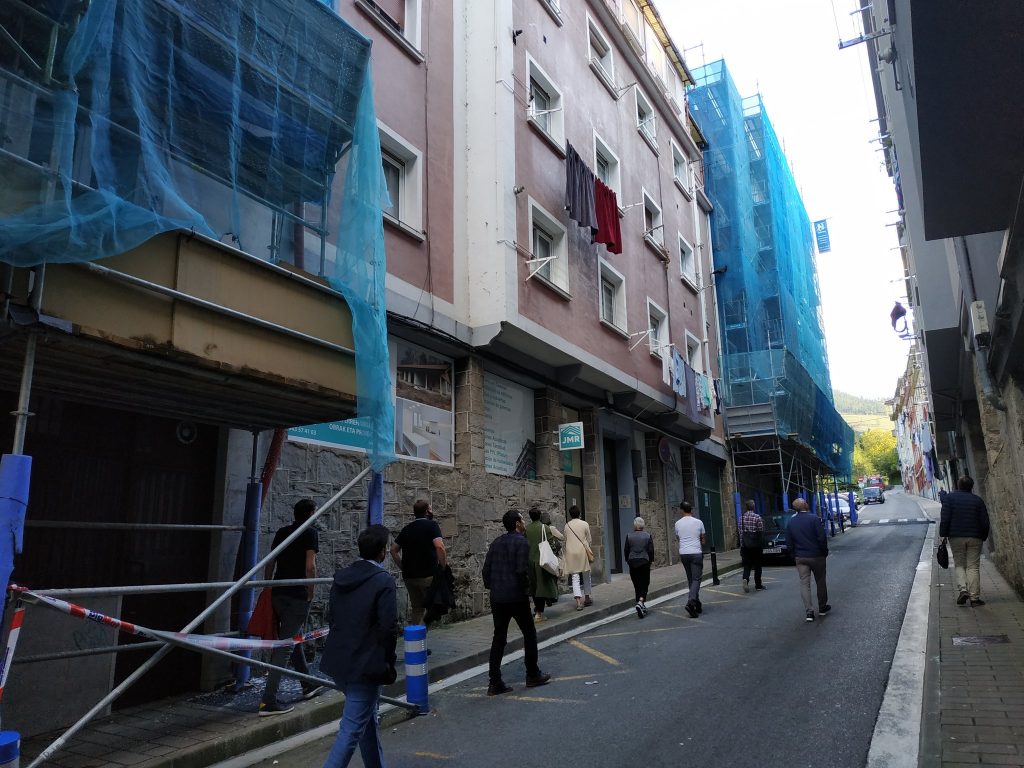
Residents of the Otxarkoaga neighbourhood in Bilbao who live in social housing flats and the local public body Bilbao Municipal Housing have set up an energy self-consumption association that will allow the surplus energy generated by the solar panels installed in the remodelled F Shopping Centre and in one of the five blocks of buildings being refurbished in Calle Txotena to be used to supply electricity to the homes in the area.

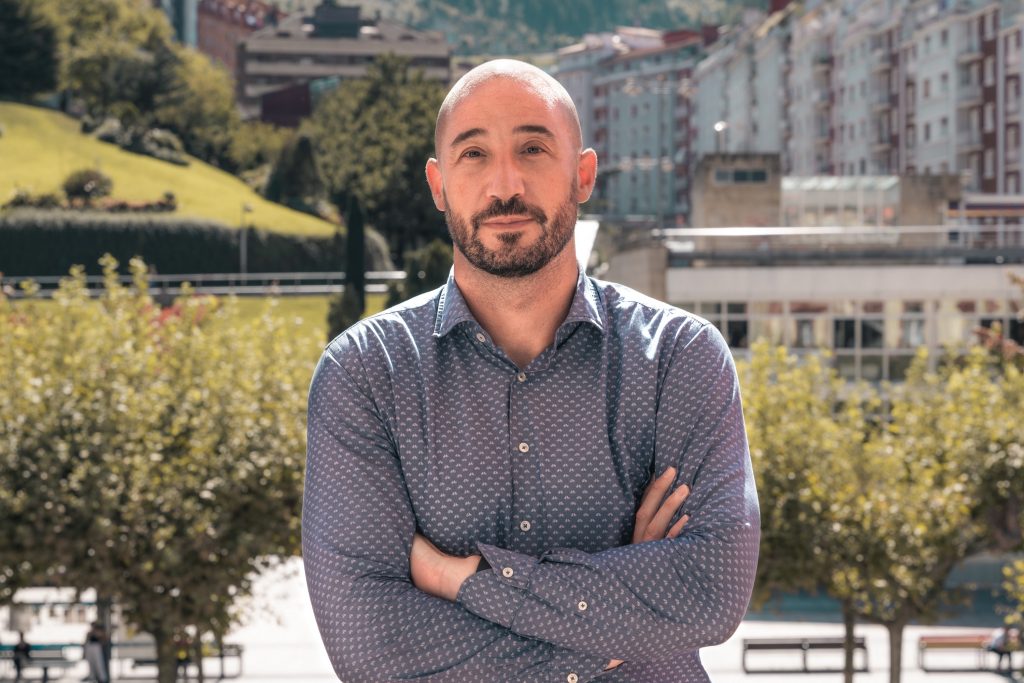
According to Jon Bilbao, Councillor for Housing and President of Municipal Housing, this initiative is part of the Orain Otxar project, which aims to turn Otxarkoaga into a socially sustainable eco-neighbourhood, with the involvement of the associative community. “This is the first experience of this nature in the city, the result of institutional collaboration and the shared commitment to the urban regeneration of the Department of Territorial Planning, Housing and Transport of the Basque Government and Bilbao Municipal Housing”.

The aim is to distribute 50% of the energy production to the shopping centre itself and the premises located in its facilities, and the remaining 50% to the surrounding houses numbers and homes, within a radius of fewer than 500 metres.

In this way, the planned distribution contemplates the supply of electricity from the surplus generated by the solar panels to 9 doorways near the shopping centre and to 11 municipally-owned dwellings located in Txotena and Irumineta streets. The aim is to provide these homes, where people with vulnerability problems live, with clean energy from renewable sources.

Bandera de la Unión Europa

This project has received funding from the European Union’s Horizon 2020 research and innovation programme under grant agreement No 846707.

Otxar Opengela

Address: Avenida Pau Casals, No. 16, Otxarkoaga, Bilbao (In front of Plaza Kepa Enbeita)

Telephone: 946 85 19 32

E-mail: otxaropengela@vvmm.bilbao.eus

Txonta Opengela

Address: Calle Txonta No. 3, ground floor, Eibar

Telephone: 688 77 97 37

E-mail: txontabulegoa@eibar.eus

Copyright@2019 | All rights reserved | Legal notice | Icono de Twitter  Icono de Youtube

Copyright@2019 | All rights reserved | Legal notice Icono de Twitter  Icono de Youtube

Opengela, as an example of urban regeneration in the Basque Country in a training day

Opengela, as an example of urban regeneration in the Basque Country in a training day

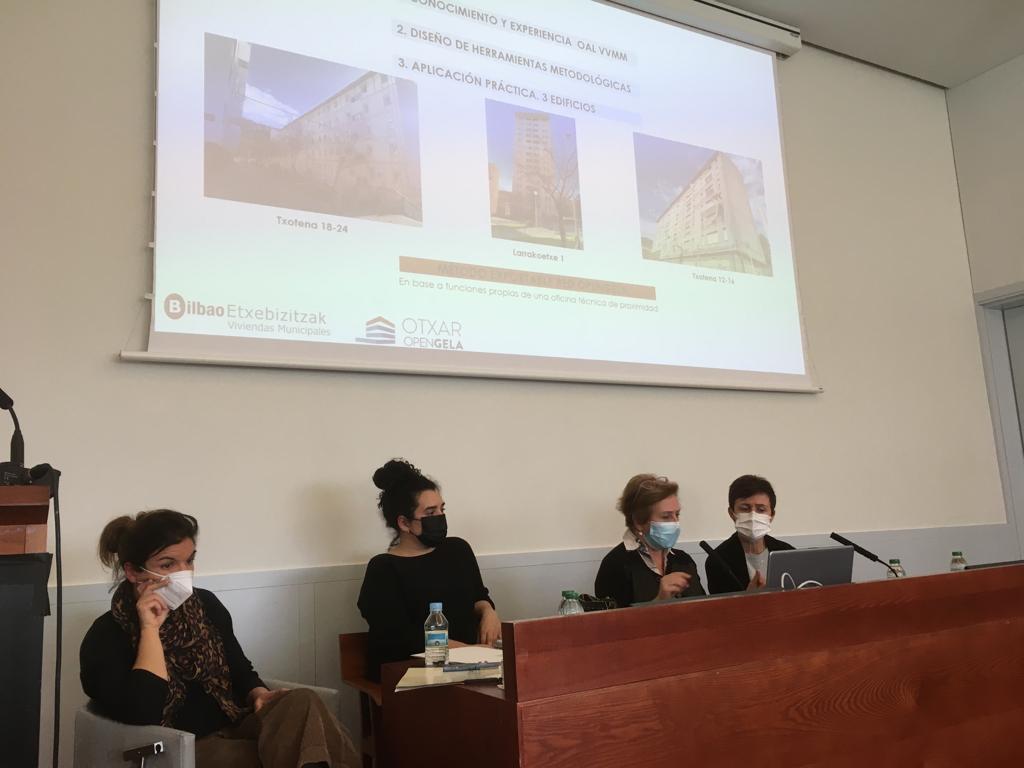
Representatives of Bilbao Municipal Housing and Debegesa during their intervention.

  • A course of the Basque Institute of Public Administration (IVAP), aimed at civil servants and profesional, presents the cases of integral refurbishment in Otxarkoaga (Bilbao) and Txonta (Eibar), as well as in Lasarte-Oria and Durango.
  • In addition, Ignacio de la Puerta, Director of Territorial Planning and Urban Agenda of the Basque Government, explains the different actions that are being carried out in the Basque Country in terms of urban regeneration.
  • On the other hand, Gerardo Ruiz, architect and professor of the Polytechnic University of Madrid, presented the great economic and social potential of urban regeneration presents in Basque neighbourhoods.

A training day organised on Tuesday 16 February by the Basque Institute of Public Administration (IVAP) has oriented civil servants and professionals in the Basque Country on the technical and organisational aspects of urban regeneration. In order to make this known, it used the Opengela project, which is developing two pilot projects in Otxarkoaga (Bilbao) and Txonta (Eibar).

The aim of the course was to show the regulatory and administrative frameworks in the field of urban regeneration and the scales at which it can be developed, as well as to learn about technical and organisational aspects.

Representatives of two of Opengela’s partners, Bilbao Municipal Housing and Debegesa, have presented the comprehensive refurbishment they are carrying out in Otxarkoaga and Txonta. In the Bilbao neighbourhood, work is being carried out on five buildings which with a total of 16 house numbers and 240 homes. In the case of Txonta, the work is being carried out on 221 homes of 17 house numbers.

For his part, the Director of Territorial Planning and Urban Agenda of the Basque Country, Ignacio de la Puerta, was in charge of presenting the actions being carried out in the Basque Country in urban matters, including Opengela, the project driven by the Basque Government which looks to improve quality of life in cities through urban regeneration.

Gerardo Ruiz Palomeque, professor at the School of Architecture of the Polytechnic University of Madrid and who collaborates with the Basque Government in the development of these actions, also participated in the conference. In his lecture, he explained the great economic and social potential of urban regeneration in the Basque neighbourhoods.

In addition to the representatives of Debegesa and Bilbao Municipal Housing, who coordinates the Txonta and Otxarkoaga offices, those responsible for two offices where the Opengela model has begun to be replicated, in the neighbourhoods of Aramotz (Durango) and Basaundi Bailara (Lasarte-Oria), aso participated and explained the actions they are carrying out.

The conference also included the sociologist Aitor Vallejo, founder of the European Research Survey, and the architect Sonia De Gregorio, who spoke about urban regeneration and the gender perspective.

Bandera de la Unión Europa

This project has received funding from the European Union’s Horizon 2020 research and innovation programme under grant agreement No 846707.

Otxar Opengela

Address: Avenida Pau Casals, No. 16, Otxarkoaga, Bilbao (In front of Plaza Kepa Enbeita)

Telephone: 946 85 19 32

E-mail: otxaropengela@vvmm.bilbao.eus

Txonta Opengela

Address: Calle Txonta No. 3, ground floor, Eibar

Telephone: 688 77 97 37

E-mail: txontabulegoa@eibar.eus

Copyright@2019 | All rights reserved | Legal notice | Icono de Twitter  Icono de Youtube

Copyright@2019 | All rights reserved | Legal notice Icono de Twitter  Icono de Youtube

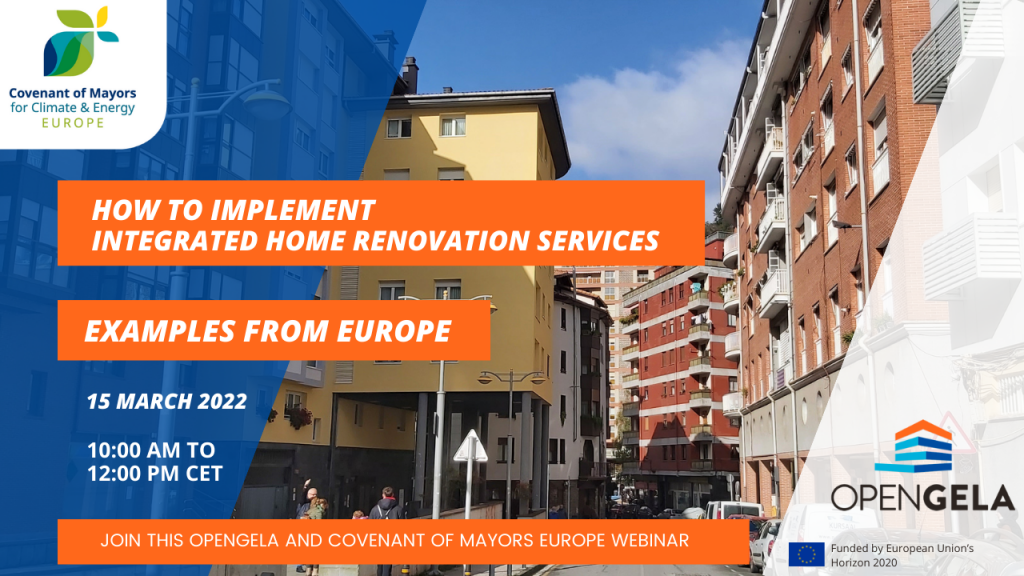
Webinar: How to implement Integrated Home Renovation Services – Examples from Europe

Webinar: How to implement Integrated Home Renovation Services – Examples from Europe

  • On 15th March 2022, Opengela and the Covenant of Mayors – Europe invite other IHRS from around Europe to show how they set up their One-Stop-Shop and their particularities.

Urban regeneration is one of the key sectors for an energy-efficient Europe. Because only 1% of buildings undergo energy-efficient renovation every year, effective action is crucial to making Europe climate-neutral (net-zero emissions) by 2050.

Following the publishing of the European Commission’s Proposals for revision of pieces of legislation, as part of the Green Deal, special attention was given to the renovation of buildings. However, building renovation is not always an easy path to follow for all citizens. Apart from the typical burden when one renovates its home, the difficulties to find and afford certified professionals may be one too many. To counter this downfall, many cities and regions in Europe have developed services to help their population in their renovation journey.

This includes the Integrated Home Renovation Services (IHRS), like one-stop-shops or online platforms, which play an important advice and information centre for citizens or professionals. Integrated Home Renovation Services is a hot topic, as proofs in the publication of Adrien Bullier and Christophe Milin: Towards large-scale roll out of “integrated home renovation services” in Europe.

In this joint webinar, Opengela and the Covenant of Mayors for Climate and Energy – Europe invite other IHRS projects and programmes from around Europe to show how they set up their One-Stop-Shop and their particularities.

Agenda

10:00WelcomingJose Ramon Lopez, Basque Energy Agency – EVE
10:102050 CommitmentsMariangela Luceri, Covenant of Mayors Europe
10:20Towards large-scale roll out of “integrated home renovation services” in EuropeChristophe Milin, CINEA
10:35OPENGELAAndoni Hidalgo, Euriker, Spain
10:55Superhomes2030Seamus Hoyne, Tipperary Energy Agency, Ireland (TBC)
11:10GIDomusJordi Ayats, Municipality of Olot, Spain
11:25Q&A 
12:00Greetings and closure of the webinarJose Ramon Lopez, Basque Energy Agency – EVE
Bandera de la Unión Europa

This project has received funding from the European Union’s Horizon 2020 research and innovation programme under grant agreement No 846707.

Otxar Opengela

Address: Avenida Pau Casals, No. 16, Otxarkoaga, Bilbao (In front of Plaza Kepa Enbeita)

Telephone: 946 85 19 32

E-mail: otxaropengela@vvmm.bilbao.eus

Txonta Opengela

Address: Calle Txonta No. 3, ground floor, Eibar

Telephone: 688 77 97 37

E-mail: txontabulegoa@eibar.eus

Copyright@2019 | All rights reserved | Legal notice | Icono de Twitter  Icono de Youtube

Copyright@2019 | All rights reserved | Legal notice Icono de Twitter  Icono de Youtube

“Opengela has made it easier for us to rehabilitate not only buildings in Otxarkoaga, but also spaces that were in disuse”

Interview

“Opengela has made it easier for us to rehabilitate not only buildings in Otxarkoaga, but also spaces that were in disuse”

Jon Bilbao

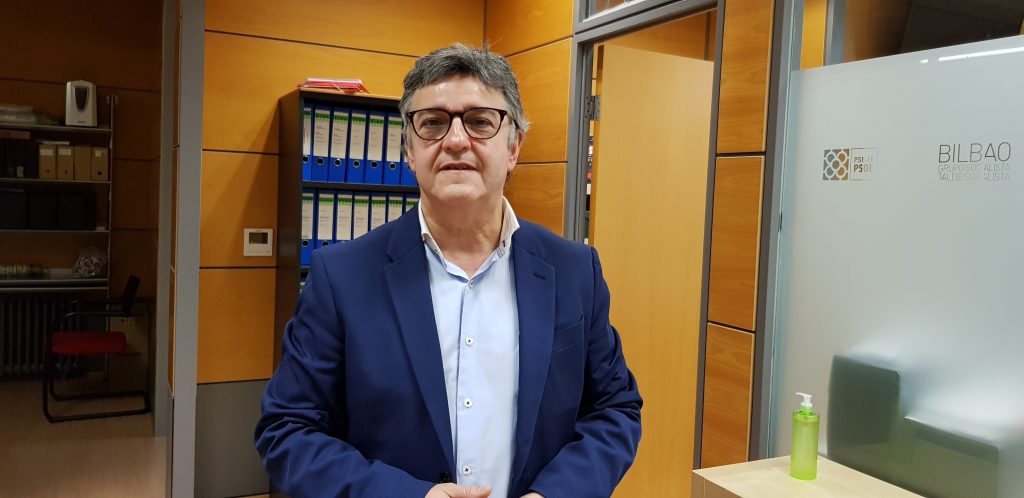
Jon Bilbao, Councillor for Housing and President of the Bilbao Municipal Housing Association.

The city of Bilbao is promoting one of the two pilot experiences of the Opengela project. The Otxarkoaga neighbourhood has set up an office to help the neighbourhood throughout the process of refurbishing its buildings. Within the scope of this European project, five blocks of buildings with 16 portals and a total of 240 dwellings are being rehabilitated. 

In the case of Otxarkoaga, unlike the other pilot project in Txonta (in Eibar), the particularity lies in the fact that most of the housing (around 60%) is publicly owned, through the company Viviendas Municipales de Bilbao. Its president, in addition to being the councillor responsible for Housing, is Jon Bilbao. 

Bilbao City Council has an ambitious urban regeneration plan for the Otxarkoaga neighbourhood, with the Orain Otxar plan. Within this framework, there is the Opengela project and the neighbourhood office that has been operating for almost two years. How do you assess the progress of the project so far? 

It has been a very positive experience. The project has enabled us to rehabilitate not only residential buildings, but also spaces that were in disuse in the neighbourhood, giving them new life and services for Otxarkoaga. The office allows us to have a local view of the progress of the refurbishment work and to have a real awareness of what is happening in each dwelling and thus be able to make better decisions.  

In this case, the City Council, as well as being the driving force behind the project, is also the owner of many of the homes that form part of it. What lessons and conclusions can be drawn from this dual status? 

We had already carried out similar projects in Otxarkoaga and other neighbourhoods in Bilbao, which allowed us to use the experience we had gained in this project. The idea of tackling projects in public-private properties seems to us to be a great success that benefits both parties. The owners are delighted to be able to count on the professionalism and involvement of the Municipal Housing workers in the projects and we are delighted to be able to count on them in the various participatory projects, as well in the day-to-day running of the works.

How is the neighbourhood reacting to the creation of the office and all that it entails, and what receptivity and encouragement do you see? 

We believe that the office is working very well. The people who are affected by the works know where to go with any doubts that may arise in a project of this magnitude and it allows us to organise ourselves better with all the agents involved in these processes. 

This is a vulnerable neighbourhood, what difficulties are you encountering in intervening there, and how are you dealing with them? 

The great difficulty is the uncertainty that comes with these major rehabilitation works, nothing that does not happen in other neighbourhoods. We deal with the problems one by one and try to provide ‘ad hoc’ solutions to each of the queries. Transparency and constant information about the projects help to deal with the inconvenience of such lengthy projects. 

How is the financing of building renovation projects being resolved? 

This is currently being channelled using a programme of instalments over a long period, combined with public financing via subsidies and the added improvements of financing from private entities and the construction companies awarded the works. A specific working methodology has been developed. 

The European project will end in 2022. With the knowledge already accumulated over the years, what would you say to any other municipality interested in applying this model, both in the Basque Country and at the European level? 

They should be encouraged to set up this type of mechanism in their municipalities. Many neighbourhoods need to undertake this type of projects and having neighbourhood offices facilitates the task of individualised assistance. 

Bandera de la Unión Europa

This project has received funding from the European Union’s Horizon 2020 research and innovation programme under grant agreement No 846707.

Otxar Opengela

Address: Avenida Pau Casals, No. 16, Otxarkoaga, Bilbao (In front of Plaza Kepa Enbeita)

Telephone: 946 85 19 32

E-mail: otxaropengela@vvmm.bilbao.eus

Txonta Opengela

Address: Calle Txonta No. 3, ground floor, Eibar

Telephone: 688 77 97 37

E-mail: txontabulegoa@eibar.eus

Copyright@2019 | All rights reserved | Legal notice | Icono de Twitter  Icono de Youtube

Copyright@2019 | All rights reserved | Legal notice Icono de Twitter  Icono de Youtube

Opengela brings its urban regeneration model to Abanto-Zierbena, Trápaga eta Santurtzi with three new neighbourhood offices

Opengela brings its urban regeneration model to Abanto-Zierbena, Trápaga eta Santurtzi with three new neighbourhood offices

The three municipalities will benefit from the funds of the Berpiztu programme, through which the Department of Territorial Planning, Housing and Transport will allocate 17 million euros to strengthen urban regeneration actions in neighbourhoods in the Basque Country between 2021 and 2023.

Opengela is taking its urban regeneration model to the Ezkerraldea-Meatzaldea region, where it will set up three new neighbourhood offices in the municipalities of Abanto-Zierbena, Valle de Trápaga-Trapagaran and Santurtzi.

This measure is part of the Berpiztu programme, with which the Department of Territorial Planning, Housing and Transport will allocate 17 million euros to strengthen urban regeneration actions in neighbourhoods in the Basque Country between 2021 and 2023. The direct subsidy to these town councils, in addition to Portugalete, was approved by the Governing Council, at the proposal of Iñaki Arriola, Minister of Territorial Planning, Housing and Transport.

In the three cases, Abanto-Zierbena, Valle de Trápaga-Trapagaran and Santurtzi, highly vulnerable neighbourhoods have been identified in which, according to preliminary analyses, the average income per household does not exceed 15,000 euros per-home per year. In the three cases, a neighbourhood office (known as opengelas) will be set up to accompany and advise residents and communities on how to carry out and finance the works, and families with the greatest economic difficulties will be given access to a guarantee fund for complementary financing to help them pay for the works.

In the case of Abanto-Zierbena, the direct subsidy of 6.28 million euros between 2021 and 2023 will be earmarked for the Peñucas neighbourhood, an area of 200 homes spread over 20 portals (seven blocks). The comprehensive action will consist of energy rehabilitation, accessibility, habitability, security and digitalisation of buildings and housing, the redevelopment of the area paying attention to accessibility, energy rehabilitation of the municipal euskaltegi, employment plans, financing and studies of the neighbourhood.

In the case of Valle de Trápaga-Trapagaran, for its part, the direct subsidy of 3.91 million will go to the San Andrés neighbourhood, where 195 homes will participate in the urban regeneration project. The intervention will cover the refurbishment of buildings and dwellings in terms of energy efficiency and various urban planning actions in terms of environmental sustainability, as well as the analysis of the reuse of obsolete buildings and actions for social inclusion, employment and R+D+i.

In Santurtzi, the Basque Government grants a direct subsidy of 3.42 million euros to refurbish a group of buildings housing 104 dwellings -Aurora Vildosola 1-13-.

The aid to these three new town councils will increase the number of neighbourhoods in the Basque Country that form part of the network of municipalities with urban regeneration projects underway. At the moment, those of Bilbao, Durango, Eibar and Lasarte-Oria are active, initiatives that are improving the quality of life of around 2,000 people living in 741 dwellings divided into 42 buildings.

The Opengela model is based on the implementation of district offices, which unify the regeneration processes of the neighbourhoods, serving both the neighbourhood and coordinating the rest of the groups involved. Opengela, which starts with two pilot projects in the neighbourhoods of Otxarkoaga (Bilbao) and Txonta (Eibar), seeks to be replicable throughout the Autonomous Community and to this end establishes guidelines that facilitate scalability to other territories.

Bandera de la Unión Europa

This project has received funding from the European Union’s Horizon 2020 research and innovation programme under grant agreement No 846707.

Otxar Opengela

Address: Avenida Pau Casals, No. 16, Otxarkoaga, Bilbao (In front of Plaza Kepa Enbeita)

Telephone: 946 85 19 32

E-mail: otxaropengela@vvmm.bilbao.eus

Txonta Opengela

Address: Calle Txonta No. 3, ground floor, Eibar

Telephone: 688 77 97 37

E-mail: txontabulegoa@eibar.eus

Copyright@2019 | All rights reserved | Legal notice | Icono de Twitter  Icono de Youtube

Copyright@2019 | All rights reserved | Legal notice Icono de Twitter  Icono de Youtube

Five European regions and cities to replicate the Opengela model

Five European regions and cities to replicate the Opengela model

  • Five entities from Croatia, Spain and Romania have been selected to bring the Opengela model to their respective regions.

The Replication call launched last October by FEDARENE, the European Federation of Energy and Environment Agencies and Regions, has resulted in the selection of five European regional and local authorities out of nine candidates one in Romania, two in Croatia and two in Spain, to export the Opengela model to their territories. Each of them is either already engaged in housing renovation projects in its territory, or is planning to do so in the near future.

The initiative will give the selected authorities access to the keys of the Opengela model, which is being developed in two pilot neighbourhoods in the Basque Country: in Txonta (Eibar) and Otxarkoaga (Bilbao). To this end, they will visit the two neighbourhoods on 31 March and 1 April 2022 to learn about their experience and to be able to transfer this model to their own projects, creating a network of ‘Opengelas’ throughout Europe.

First, the municipality of Sighetu Marmatiei, in Romania, is currently immersed in a project that aims to improve the accessibility of the municipality and the living conditions of the population in some areas, introducing a new rainwater drainage network and another sewerage network, among other initiatives. Sighetu Marmatiei municipality is joined by two regions in Croatia.

The first one is Medjimurje County, which comprises three cities and 22 smaller-scale municipalities. It is represented by the regional energy agency MENEA which acts as an advisory centre for energy and climate issues and is currently in the process of expanding its services, aiming to integrate a home renovation service in a collaborative way and ensuring financial sustainability.

The second one covers the counties of Varazdin, Koprivnica-Krizevci and Virovitica-Podravina, represented by the regional energy agency North, REA North, which has already started to provide consultations and technical guidance related to home renovation. However, they are looking for ideas to address the financial side and questions on how to establish an innovative citizen-driven one-stop-shop model at local/regional level.

The last two selected regions are in Spain, one is the Extremadura region and the other is Lleida municipality. In Extremadura, the energy agency AGENEX, which has already participated in European projects such as INNOVATE or HousEEnvest, is looking for ideas and experiences to address social housing from a perspective in which homeowners are involved, in addition to the search for sustainable financial tools.

Lleida, for its part, is committed to designing and implementing a one-stop-shop renovation office to improve the energy performance of the building stock, within a year. To this end, they want to develop instruments to overcome the main barriers such as lack of knowledge, lack of interest or financing, in order to accelerate the energy transition of their city.

Bandera de la Unión Europa

This project has received funding from the European Union’s Horizon 2020 research and innovation programme under grant agreement No 846707.

Otxar Opengela

Address: Avenida Pau Casals, No. 16, Otxarkoaga, Bilbao (In front of Plaza Kepa Enbeita)

Telephone: 946 85 19 32

E-mail: otxaropengela@vvmm.bilbao.eus

Txonta Opengela

Address: Calle Txonta No. 3, ground floor, Eibar

Telephone: 688 77 97 37

E-mail: txontabulegoa@eibar.eus

Copyright@2019 | All rights reserved | Legal notice | Icono de Twitter  Icono de Youtube

Copyright@2019 | All rights reserved | Legal notice Icono de Twitter  Icono de Youtube

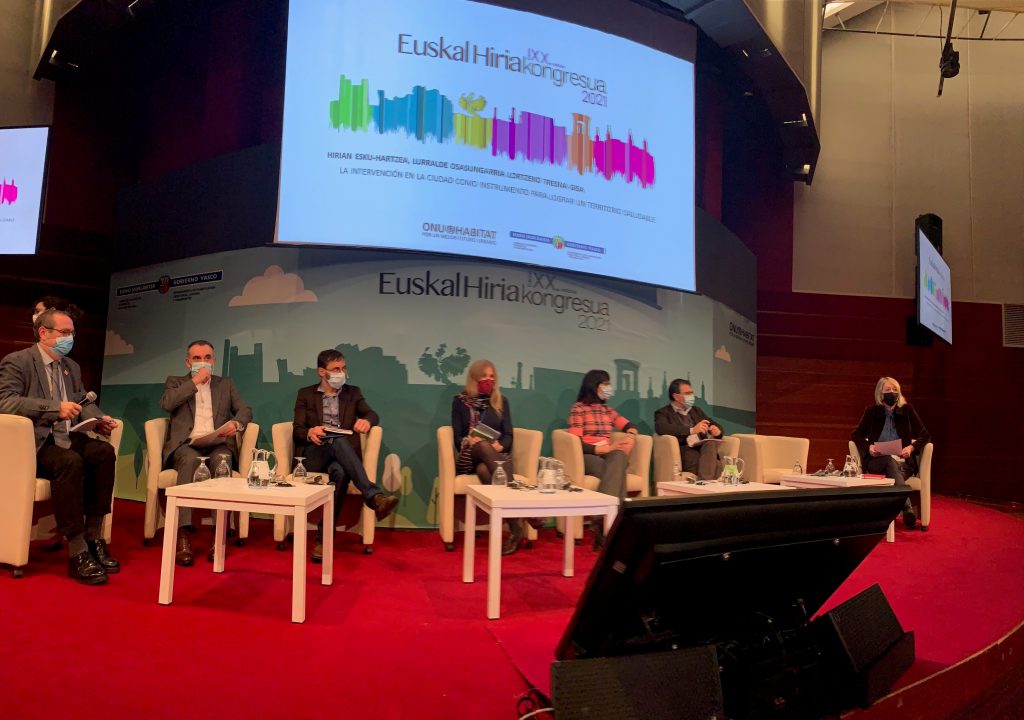
The Euskal Hiria congress highlights the role of urban regeneration and the Opengela model

The Euskal Hiria congress highlights the role of urban regeneration and the Opengela model

Opengela en Euskal Hiria 2021
  • This forum, organised by the Basque Government and UN-Habitat at the end of November, stressed the need to recover cities, focusing on social and environmental aspects.

The Euskal Hiria congress held its twentieth edition this year. It is a classic event for experts in territorial planning, an area in which the Basque Country has excelled in recent decades. On this occasion, the focus was on the social and environmental transformation of cities, and it focused on specific cases of urban regeneration in vulnerable areas of the Basque Country, especially the Opengela model.

The importance of urban regeneration took centre stage at this congress held in Vitoria-Gasteiz. In a keynote speech, Ignacio de la Puerta, Director of Territorial Planning and Urban Agenda of the Basque Government, explained the need to “recover cities”. A study by the Government itself reveals that, despite the last 40 years of public investment, “30% of the Basque Country’s neighbourhoods are in conditions of high or very high vulnerability”, as well as “the relationship between vulnerability and health”.

To tackle this situation, the Basque Government has proposed a PERTE (Strategic Project for Economic Recovery and Transformation) for integral urban regeneration, a project open to multiple agents to intervene in 47 municipalities. To carry it out, it is proposed to “extend the Opengela model”, funded by the European Commission.

Ignacio de la Puerta, Director of Territorial Planning and Urban Agenda of the Basque Government, stressed the importance of generating “trust” with the neighbourhood, “raising awareness of the benefits of intervention to improve comfort and habitability”, carrying out a “diagnosis of economic, social and cultural aspects”, promoting employment opportunities and “offering a space for meeting and trust that functions as a one-stop shop”. In this sense, the Opengela model promotes the creation of proximity offices in each neighbourhood, which accompany the neighbourhood in the process of urban regeneration”. He also pointed out the novelty that it provides “fair and affordable financing for all”.

On the opening day, Iñaki Arriola, Basque Government Minister of Territorial Planning, Housing and Transport, encouraged us to “consider the promotion of new urban models that allow the different fabrics that make up our cities to coexist and improve their interrelation with the rural and natural environment, through a new configuration and use of public spaces and a new mobility”.

To achieve this, the Basque Country has equipped itself with a fundamental tool: the Bultzatu 2050 Urban Agenda, one of the first to be drawn up at regional level and which is aligned with the United Nations New Urban Agenda and the Sustainable Development Goals (SDGs). In this regard, Iñaki Arriola highlighted urban regeneration as a way to achieve “the transformation of cities towards fairer and more sustainable cities”.

The Basque Country already has several experiences in this area, which involves not only the rehabilitation of buildings, the improvement of energy efficiency and the accessibility of housing, but with a broader sense and consequences in social, economic, environmental and governance aspects. Opengela served as an example on several occasions for the speakers at the congress.

During Euskal Hiria, the head of UN-Habitat’s Spain office, Carmen Sánchez-Miranda, stressed that “if the Sustainable Development Goals are the What, the urban agendas are the How. UN-Habitat has been accompanying the Basque Agenda Bultzatu 2050 since its creation, convinced that the territorial level is a key level in the processes of implementation, coordination and promotion of effective governance, and that the role of sub-national governments is just as important as that of the national and local levels in this regard”.

The head of UN-Habitat in Spain added that “the way in which towns and cities recover from the pandemic will have a major impact on global efforts to achieve a sustainable future for all (…) the Sustainable Development Goals are precisely the articulating rails capable of ensuring that the short lights of the emergency are aligned with the long lights of development”. Euskal Hiria served as a contrast between experiences at a more local level and others at a global level.

Bandera de la Unión Europa

This project has received funding from the European Union’s Horizon 2020 research and innovation programme under grant agreement No 846707.

Otxar Opengela

Address: Avenida Pau Casals, No. 16, Otxarkoaga, Bilbao (In front of Plaza Kepa Enbeita)

Telephone: 946 85 19 32

E-mail: otxaropengela@vvmm.bilbao.eus

Txonta Opengela

Address: Calle Txonta No. 3, ground floor, Eibar

Telephone: 688 77 97 37

E-mail: txontabulegoa@eibar.eus

Copyright@2019 | All rights reserved | Legal notice | Icono de Twitter  Icono de Youtube

Copyright@2019 | All rights reserved | Legal notice Icono de Twitter  Icono de Youtube

Ignacio de la Puerta: “We are interested in intervening in the housing stock to improve the living conditions and health of citizens”

Ignacio de la Puerta: “We are interested in intervening in the housing stock to improve the living conditions and health of citizens”

Visita UIPI a la Otxar Opengela
  • The director of Territorial Planning and Urban Agenda of the Basque Government and coordinator of Opengela, presented the urban regeneration project being developed in the Basque Country to the International Union of Property Owners (UIPI).
  • The conference held at the Palacio de Villasuso in Vitoria-Gasteiz brought together institutional representatives who explained what is expected at European, national and local level in terms of regulations and support plans focused on energy efficiency.
  • In addition, attendees had the opportunity to visit the refurbishment works of the pilot project being carried out in Otxarkoaga (Bilbao).

The renovation of the building stock and the improvement of the energy efficiency of buildings is one of the objectives pursued by the European Union. To this end, it has set up different regulations and financial support systems such as the Next Generation funds. The conference ‘Basque property owners on board’, organised by the International Union of Property Owners (UIPI), brought together institutional representatives on 28 October in Vitoria and Bilbao (Basque Country) to put into context what is expected at EU, national and local level in terms of regulations and support schemes focused on energy efficiency.

One of the speakers was Ignacio de la Puerta, director of Territorial Planning and Urban Agenda of the Basque Government, who stressed the need to intervene in the housing stock “to improve the living conditions and health of citizens”. De la Puerta also had the opportunity to present Opengela, the project to set up neighbourhood offices to promote urban regeneration that is currently being carried out in five neighbourhoods in the Basque Country – Otxarkoaga (Bilbao), Txonta (Eibar), Aramotz (Durango), Basaundi (Lasarte) and Pasaia. “With the Opengela project, we are working on the one-stop shop model for the integral attention of citizens in urban regeneration, with the aim of extending this model to the whole of the Basque Country”, he explained.

The Opengela coordinator also pointed out the importance of the neighbourhood offices already operating in Otxarkoaga and Txonta to reach out to citizens: “It’s about providing a support service where the fundamental thing is to gain the trust of those who are going to be affected by the interventions, and to convey in simple terms the benefits of these works, which are not only related to energy efficiency, but also to improvements in living conditions”.

Visit to Otxar Opengela

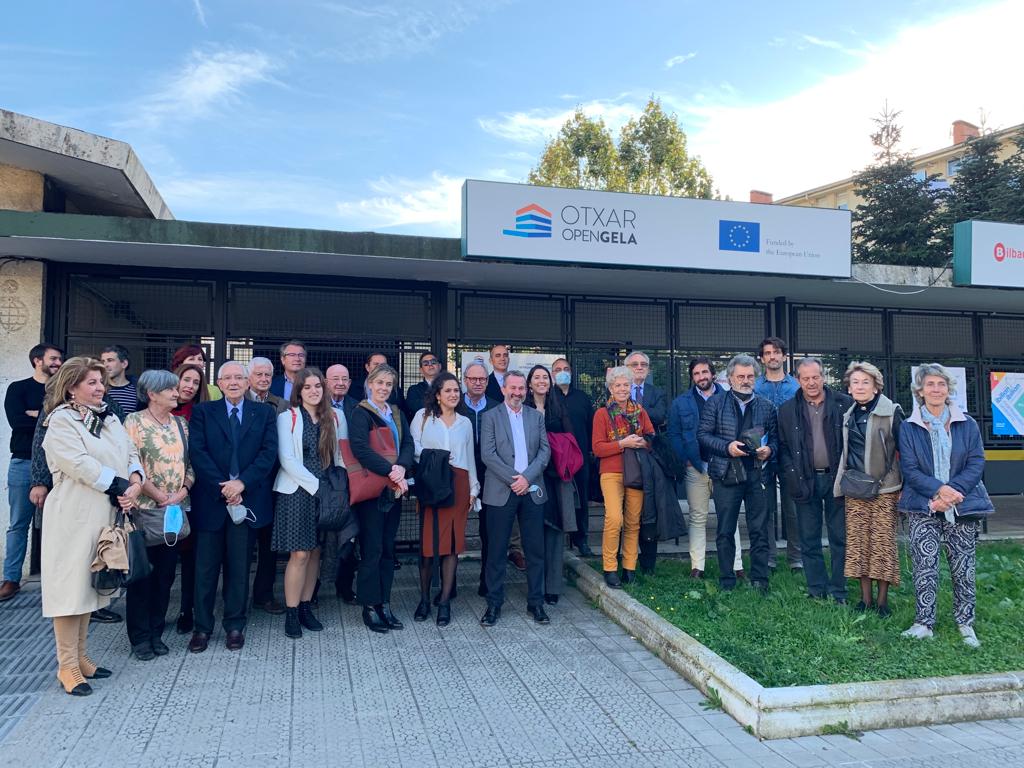
The attendees had the opportunity to learn first-hand about the work carried out in the neighbourhood offices set up by Opengela, with a visit to the Otxar Opengela in the Otxarkoaga district of Bilbao. Regarding these offices, Ignacio de la Puerta highlighted their capacity to act as a multifunctional space: “We also use this space as a space for knowledge, where, for example, courses can be given and new employment opportunities can be developed”.

The day ended with a visit to the Otxarkoaga buildings where rehabilitation work has begun. Opengela serves the neighbourhood of 16 portals and 240 homes in the neighbourhood, where the old shopping centre has also been remodelled and entrepreneurship initiatives have been launched in premises that were previously closed.

Bandera de la Unión Europa

This project has received funding from the European Union’s Horizon 2020 research and innovation programme under grant agreement No 846707.

Otxar Opengela

Address: Avenida Pau Casals, No. 16, Otxarkoaga, Bilbao (In front of Plaza Kepa Enbeita)

Telephone: 946 85 19 32

E-mail: otxaropengela@vvmm.bilbao.eus

Txonta Opengela

Address: Calle Txonta No. 3, ground floor, Eibar

Telephone: 688 77 97 37

E-mail: txontabulegoa@eibar.eus

Copyright@2019 | All rights reserved | Legal notice | Icono de Twitter  Icono de Youtube

Copyright@2019 | All rights reserved | Legal notice Icono de Twitter  Icono de Youtube

COAVN Gipuzkoa gets to know Opengela’s pilot projects in Otxarkoaga and Txonta

COAVN Gipuzkoa gets to know Opengela’s pilot projects in Otxarkoaga and Txonta

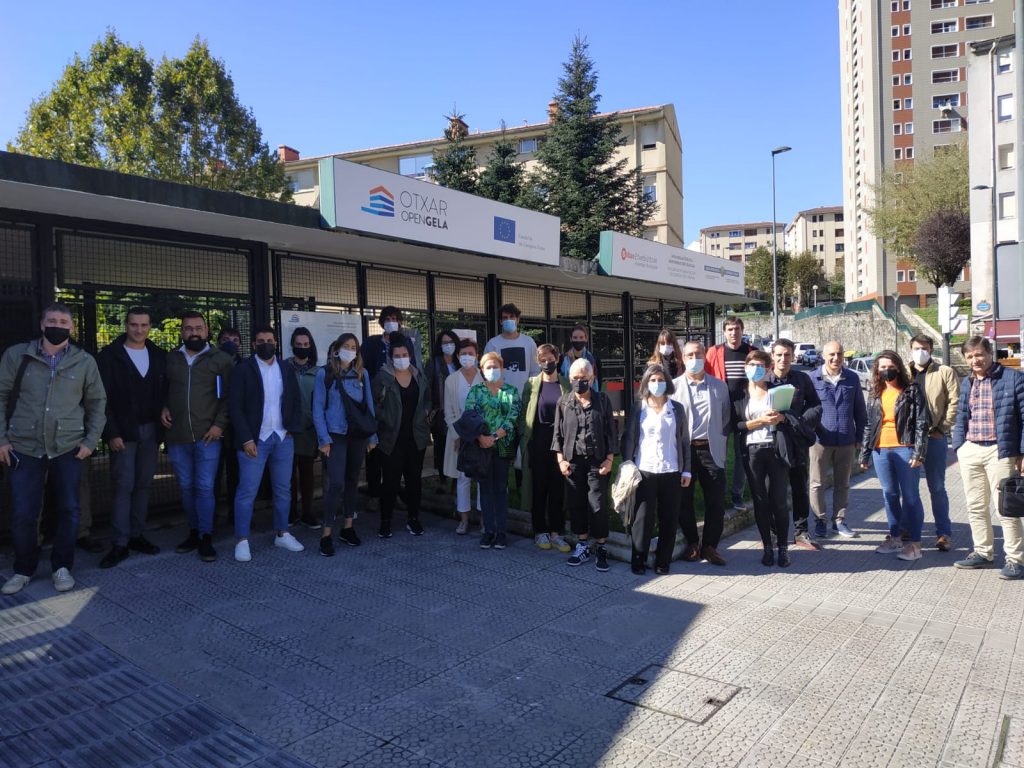
Representatives of COAVN Gipuzkoa visit the Otxar Opengela in Otxarkoaga (Bilbao)

Coinciding with World Architecture Day, on 4 October, representatives of the Gipuzkoa branch of the Official Association of Architects of the Basque Country (COAVN) visited the Otxarkoaga (Bilbao) and Txonta (Eibar) neighbourhoods, the pilot projects with which Opengela began its comprehensive urban regeneration activity in 2019.

The first destination was the Otxar Opengela, where Ignacio de la Puerta, director of Territorial Planning and Urban Agenda of the Basque Government, and coordinator of Opengela, and Claudia Penesse, member of COAVN Gipuzkoa, welcomed the attendees. De la Puerta explained what Opengela consists of, a project which, as he pointed out, “aims to accompany and advise the neighbourhood throughout the rehabilitation process”.

During their tour of the Bilbao neighbourhood, the attendees visited some of the buildings where work has begun. In total, work is being carried out on 16 houses numbers and 240 homes. In addition, the remodelling of the old shopping centre has been undertaken and entrepreneurship initiatives have been set up in premises that were previously empty.

Visit of COAVN Gipuzkoa to Txonta (Eibar)

In the afternoon, the delegation went to Opengela’s office in Txonta street (Eibar), where the refurbishment of 17 houses numbers and 221 homes is being managed, with the participation of the residents of the neighbourhood taking priority. Esther Zarrabeitia, representative of Debegesa, the company for the economic development of Debabarrena, showed the works that are being carried out with criteria of energy efficiency and accessibility, and highlighted the opportunity that the neighbourhood has to renovate their homes. “There has never been as much aid as there is now for refurbishment”, he recalled.

Bandera de la Unión Europa

This project has received funding from the European Union’s Horizon 2020 research and innovation programme under grant agreement No 846707.

Otxar Opengela

Address: Avenida Pau Casals, No. 16, Otxarkoaga, Bilbao (In front of Plaza Kepa Enbeita)

Telephone: 946 85 19 32

E-mail: otxaropengela@vvmm.bilbao.eus

Txonta Opengela

Address: Calle Txonta No. 3, ground floor, Eibar

Telephone: 688 77 97 37

E-mail: txontabulegoa@eibar.eus

Copyright@2019 | All rights reserved | Legal notice | Icono de Twitter  Icono de Youtube

Copyright@2019 | All rights reserved | Legal notice Icono de Twitter  Icono de Youtube

“The neighbourhood office is essential; it is responsible for building the necessary trust between institutions and neighbourhoods”

Interview – JON IRAOLA, MAYOR OF EIBAR

“The neighbourhood office is essential; it is responsible for building the necessary trust between institutions and neighbourhoods”

Jon Iraola, alcalde de Eibar

Jon Iraola, mayor of Eibar

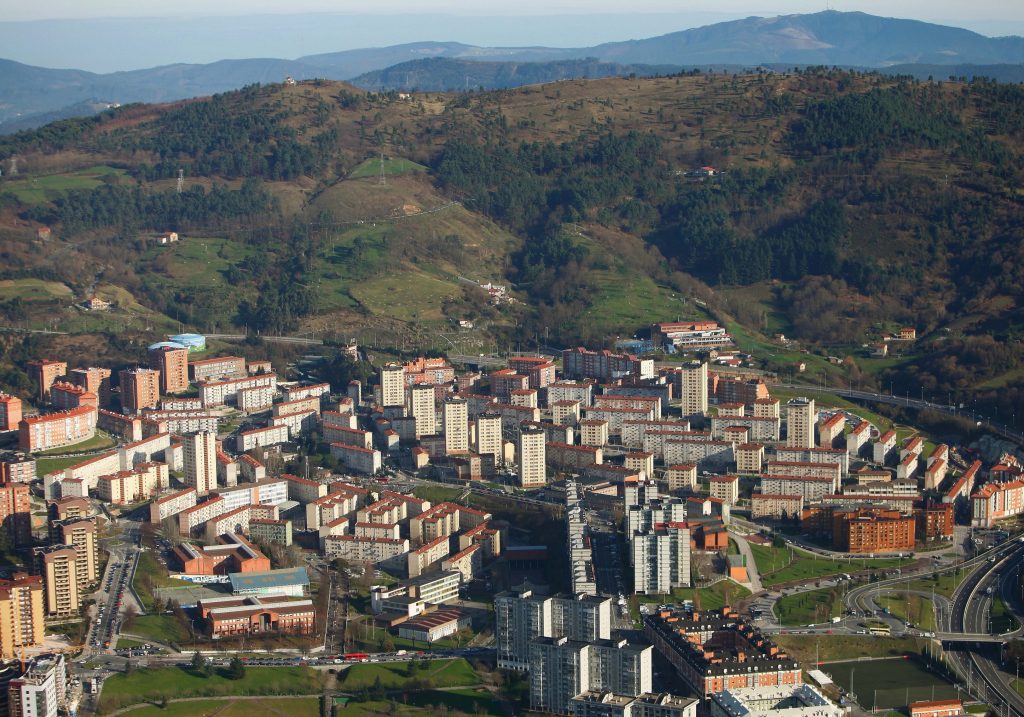
The mayor of Eibar, Jon Iraola, knows the Opengela project first hand. Until he took office in March, he was the councillor for Works, Town Planning and the Environment at the Town Council, in charge of managing matters related to urban regeneration in the Txonta neighbourhood, one of the two pilot areas of this European project. He has now added to these responsibilities by becoming the highest authority in the municipality of Gipuzkoa. 

In this interview, he gives his point of view on the progress of Opengela, a European project led by the Basque Government, in which Debegesa (the economic development company of the Debabarrena region, to which Eibar belongs) participates, which implements neighbourhood offices to undertake urban regeneration processes and is financed by the European Commission’s Horizon 2020 programme.   

You have followed the evolution of the Opengela project since it began in May 2019. What does it mean and what value does it have for Eibar? 

The Town Council and the Basque Government started working with the Txonta neighbourhood at the end of 2017, when the Government launched a grant of over 2.3 million euros, which was increased slightly to just over 2.5 million a few months ago. The Town Council is also participating with an additional grant of 400,000 euros to complement the project. 

Urban regeneration was urgently needed. Txonta is a complex neighbourhood from an urbanistic point of view and although there have been attempts in the past, the regeneration of the neighbourhood has not been completed until now. This government grant was a good opportunity to move on to the rehabilitation of the 17 apartment buildings included in the project. Opengela is also an instrument of great potential because it touches on several aspects of regeneration. On the one hand, the office itself, essential to the project, serves to articulate good practices and ways of working that can be extended to other future offices in other cities that want to rehabilitate neighbourhoods. In addition, Opengela brings with it funding, which is essential for the residents of the neighbourhood. The 17 apartment buildings are undertaking rehabilitation of facades, roofs, improving accessibility… These are works of great magnitude and of a very high economic cost. In some cases, they are buildings with few neighbours, so the burden for each neighbour is even greater. The financing offered by Opengela is essential to start the project, as the subsidies are received once the outlay has been made, but in order to be able to do it, it is necessary to have the money, and this is not always the case.  Opengela is a project that still has a lot of development. 

There are many agents involved in the project. What is the role of your Town Council in in this project? 

It has fallen to us to promote the project insofar as we have direct contact with the neighbourhood and we have been in charge of presenting the project to them. It is true that we have gone hand in hand with the Basque Government, but the Txonta office is managed by municipal staff. We have had to do a lot of pedagogical work and in many cases convince the neighbourhood of the goodness and seriousness of the project because at the beginning there was some mistrust about what was going to happen. These are logical mistrusts, insofar as they are ambitious projects, there is a lot of money involved, and it is really difficult to get people involved. We had to organise a lot of meetings and listen to what the neighbours were telling us, what their concerns were, because this also helps us to learn and enriches the project. Often these projects are designed from an abstract point of view, with the best of intentions and always thinking of the good of the neighbours, but in their development, it is necessary to listen to them, detect their real needs, their concerns, and incorporate solutions. Such a project has to meet all these needs and concerns. 

The residents must be convinced of the project, of the works they are going to undertake and that we are going to be there to help and support them. The office has done a very necessary and very important job of listening. 

As you say, the idea of promoting the urban regeneration of Txonta goes back a long way. Do you see that it is finally about to become a reality? 

-It is true that when started in 2018, it was difficult to get started. It took time for all the agents involved in the project to get to know each other and to fit all the pieces together to get the project underway. We had to overcome the mistrust of the neighbours that I mentioned earlier. I think we have achieved this to a large extent. … When planning other similar projects, we will have to take into account how long it has taken to get the Txonta project off the ground. I do not think it is possible to get an idea beforehand. For the future, when setting deadlines for the completion of projects, the experience of the neighbourhood will have to be taken into account. The Town Council and the government have also had to learn things: to listen to the concerns of the residents and to be sufficiently flexible to make the project flow better. In addition, the pandemic has slowed the project down a lot.  

You know the concerns of the residents, what do they tell you, how is the project being received? 

It was difficult for the neighbourhood to have confidence in the project, essentially because of its magnitude, and for them to believe that we were going to deliver everything we offered them. There was a certain, and reasonable, mistrust of the project. In this neighbourhood, things had been tried before and they had not worked out. The residents also demanded a lot of involvement from the institutions, and it was clear to all of us that we had to work together on this. Many concerns had to do with the financing of the works, the deadlines…  

The person who manages the office, Cristina Boyar, and Debegesa –Esther Zarrabeitia- are doing an excellent job. an important part of the success lies in how they are attending to and managing the needs of the residents.  

Do you detect any evolution since that initial mistrust? 

Yes. The projects are moving forward and some apartment buildings are already up and running. In fact, some of them have even finished the works… Almost all the apartment buildings have joined the project. The fact of seeing that the other one has done it is an incentive. There is always a need for somebody to go first. Some communities saw things very clearly, they went ahead with things and the rest have continued along the same path. 

It is true, the rehabilitation work in Txonta can already be seen, although there is still some time to go to see the results and take stock. What would you say to any other municipality interested in applying this model? 

That the neighbourhood office is essential. It has been responsible for building the necessary trust between the institutions and the neighbourhood. The residents have seen that the institutions are accompanying them in this process. Opengela also has a part of financial support, which has come to us a little late because our project was already underway. We are aware that developing the financial instrument to provide this funding is not at all easy and that the Basque Government has worked very hard to achieve it. And now it is finally a reality. There are two very important aspects. In addition to the importance of the neighbourhood office, a mature financing system is needed to help solve the initial liquidity problems involved in these works. An Opengela project with the neighbourhood office, and with a financing system that is already mature, agile, already set up, and that can be set up automatically, would be important aspects.    
Bandera de la Unión Europa

This project has received funding from the European Union’s Horizon 2020 research and innovation programme under grant agreement No 846707.

Otxar Opengela

Address: Avenida Pau Casals, No. 16, Otxarkoaga, Bilbao (In front of Plaza Kepa Enbeita)

Telephone: 946 85 19 32

E-mail: otxaropengela@vvmm.bilbao.eus

Txonta Opengela

Address: Calle Txonta No. 3, ground floor, Eibar

Telephone: 688 77 97 37

E-mail: txontabulegoa@eibar.eus

Copyright@2019 | All rights reserved | Legal notice | Icono de Twitter  Icono de Youtube

Copyright@2019 | All rights reserved | Legal notice Icono de Twitter  Icono de Youtube