Ignacio de la Puerta: “We are interested in intervening in the housing stock to improve the living conditions and health of citizens”

Ignacio de la Puerta: “We are interested in intervening in the housing stock to improve the living conditions and health of citizens”

Visita UIPI a la Otxar Opengela
  • The director of Territorial Planning and Urban Agenda of the Basque Government and coordinator of Opengela, presented the urban regeneration project being developed in the Basque Country to the International Union of Property Owners (UIPI).
  • The conference held at the Palacio de Villasuso in Vitoria-Gasteiz brought together institutional representatives who explained what is expected at European, national and local level in terms of regulations and support plans focused on energy efficiency.
  • In addition, attendees had the opportunity to visit the refurbishment works of the pilot project being carried out in Otxarkoaga (Bilbao).

The renovation of the building stock and the improvement of the energy efficiency of buildings is one of the objectives pursued by the European Union. To this end, it has set up different regulations and financial support systems such as the Next Generation funds. The conference ‘Basque property owners on board’, organised by the International Union of Property Owners (UIPI), brought together institutional representatives on 28 October in Vitoria and Bilbao (Basque Country) to put into context what is expected at EU, national and local level in terms of regulations and support schemes focused on energy efficiency.

One of the speakers was Ignacio de la Puerta, director of Territorial Planning and Urban Agenda of the Basque Government, who stressed the need to intervene in the housing stock “to improve the living conditions and health of citizens”. De la Puerta also had the opportunity to present Opengela, the project to set up neighbourhood offices to promote urban regeneration that is currently being carried out in five neighbourhoods in the Basque Country – Otxarkoaga (Bilbao), Txonta (Eibar), Aramotz (Durango), Basaundi (Lasarte) and Pasaia. “With the Opengela project, we are working on the one-stop shop model for the integral attention of citizens in urban regeneration, with the aim of extending this model to the whole of the Basque Country”, he explained.

The Opengela coordinator also pointed out the importance of the neighbourhood offices already operating in Otxarkoaga and Txonta to reach out to citizens: “It’s about providing a support service where the fundamental thing is to gain the trust of those who are going to be affected by the interventions, and to convey in simple terms the benefits of these works, which are not only related to energy efficiency, but also to improvements in living conditions”.

Visit to Otxar Opengela

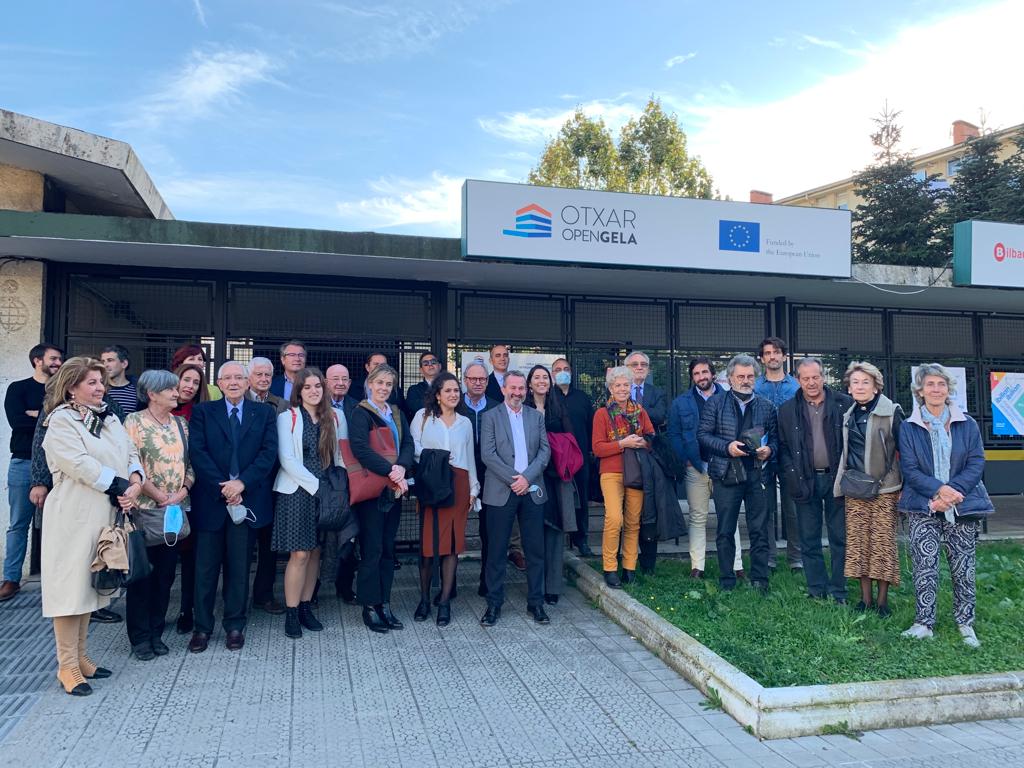
The attendees had the opportunity to learn first-hand about the work carried out in the neighbourhood offices set up by Opengela, with a visit to the Otxar Opengela in the Otxarkoaga district of Bilbao. Regarding these offices, Ignacio de la Puerta highlighted their capacity to act as a multifunctional space: “We also use this space as a space for knowledge, where, for example, courses can be given and new employment opportunities can be developed”.

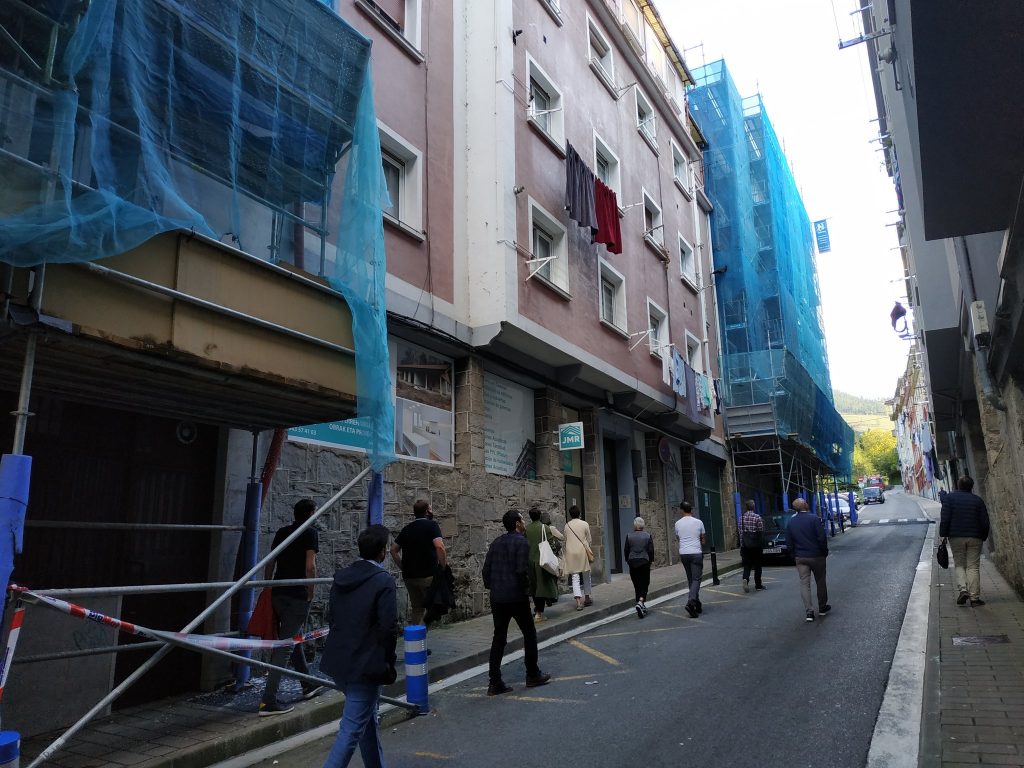
The day ended with a visit to the Otxarkoaga buildings where rehabilitation work has begun. Opengela serves the neighbourhood of 16 portals and 240 homes in the neighbourhood, where the old shopping centre has also been remodelled and entrepreneurship initiatives have been launched in premises that were previously closed.

Bandera de la Unión Europa

This project has received funding from the European Union’s Horizon 2020 research and innovation programme under grant agreement No 846707.

Otxar Opengela

Address: Avenida Pau Casals, No. 16, Otxarkoaga, Bilbao (In front of Plaza Kepa Enbeita)

Telephone: 946 85 19 32

E-mail: otxaropengela@vvmm.bilbao.eus

Txonta Opengela

Address: Calle Txonta No. 3, ground floor, Eibar

Telephone: 688 77 97 37

E-mail: txontabulegoa@eibar.eus

Copyright@2019 | All rights reserved | Legal notice | Icono de Twitter  Icono de Youtube

Copyright@2019 | All rights reserved | Legal notice Icono de Twitter  Icono de Youtube

COAVN Gipuzkoa gets to know Opengela’s pilot projects in Otxarkoaga and Txonta

COAVN Gipuzkoa gets to know Opengela’s pilot projects in Otxarkoaga and Txonta

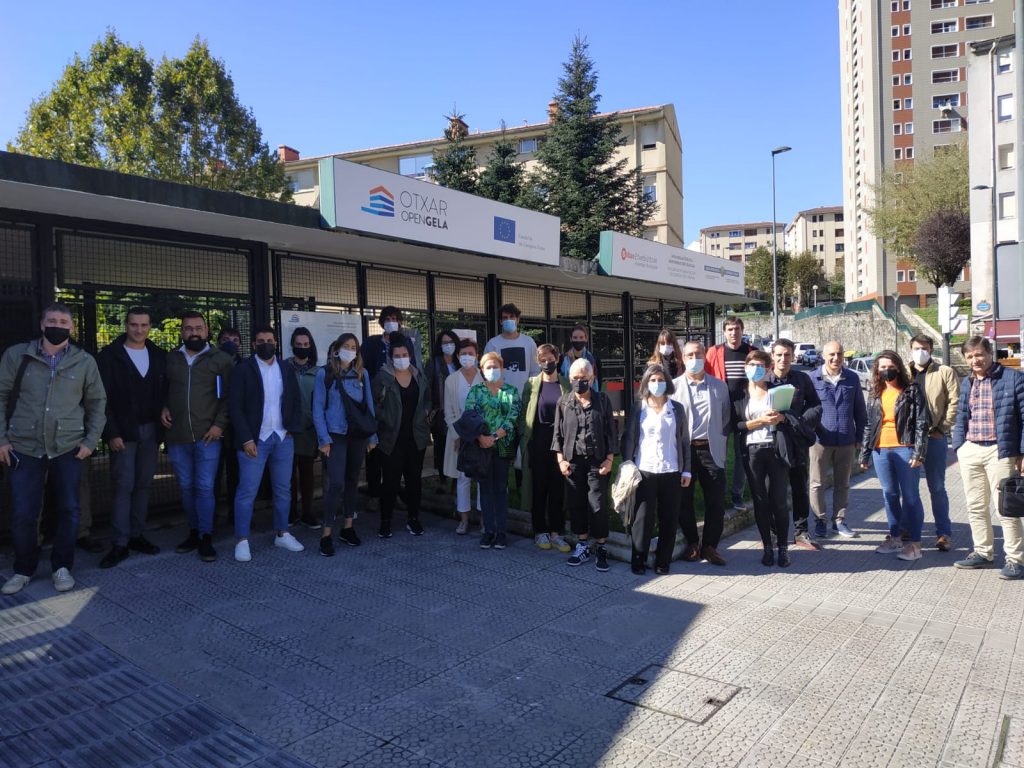
Representatives of COAVN Gipuzkoa visit the Otxar Opengela in Otxarkoaga (Bilbao)

Coinciding with World Architecture Day, on 4 October, representatives of the Gipuzkoa branch of the Official Association of Architects of the Basque Country (COAVN) visited the Otxarkoaga (Bilbao) and Txonta (Eibar) neighbourhoods, the pilot projects with which Opengela began its comprehensive urban regeneration activity in 2019.

The first destination was the Otxar Opengela, where Ignacio de la Puerta, director of Territorial Planning and Urban Agenda of the Basque Government, and coordinator of Opengela, and Claudia Penesse, member of COAVN Gipuzkoa, welcomed the attendees. De la Puerta explained what Opengela consists of, a project which, as he pointed out, “aims to accompany and advise the neighbourhood throughout the rehabilitation process”.

During their tour of the Bilbao neighbourhood, the attendees visited some of the buildings where work has begun. In total, work is being carried out on 16 houses numbers and 240 homes. In addition, the remodelling of the old shopping centre has been undertaken and entrepreneurship initiatives have been set up in premises that were previously empty.

Visit of COAVN Gipuzkoa to Txonta (Eibar)

In the afternoon, the delegation went to Opengela’s office in Txonta street (Eibar), where the refurbishment of 17 houses numbers and 221 homes is being managed, with the participation of the residents of the neighbourhood taking priority. Esther Zarrabeitia, representative of Debegesa, the company for the economic development of Debabarrena, showed the works that are being carried out with criteria of energy efficiency and accessibility, and highlighted the opportunity that the neighbourhood has to renovate their homes. “There has never been as much aid as there is now for refurbishment”, he recalled.

Bandera de la Unión Europa

This project has received funding from the European Union’s Horizon 2020 research and innovation programme under grant agreement No 846707.

Otxar Opengela

Address: Avenida Pau Casals, No. 16, Otxarkoaga, Bilbao (In front of Plaza Kepa Enbeita)

Telephone: 946 85 19 32

E-mail: otxaropengela@vvmm.bilbao.eus

Txonta Opengela

Address: Calle Txonta No. 3, ground floor, Eibar

Telephone: 688 77 97 37

E-mail: txontabulegoa@eibar.eus

Copyright@2019 | All rights reserved | Legal notice | Icono de Twitter  Icono de Youtube

Copyright@2019 | All rights reserved | Legal notice Icono de Twitter  Icono de Youtube

“The neighbourhood office is essential; it is responsible for building the necessary trust between institutions and neighbourhoods”

Interview – JON IRAOLA, MAYOR OF EIBAR

“The neighbourhood office is essential; it is responsible for building the necessary trust between institutions and neighbourhoods”

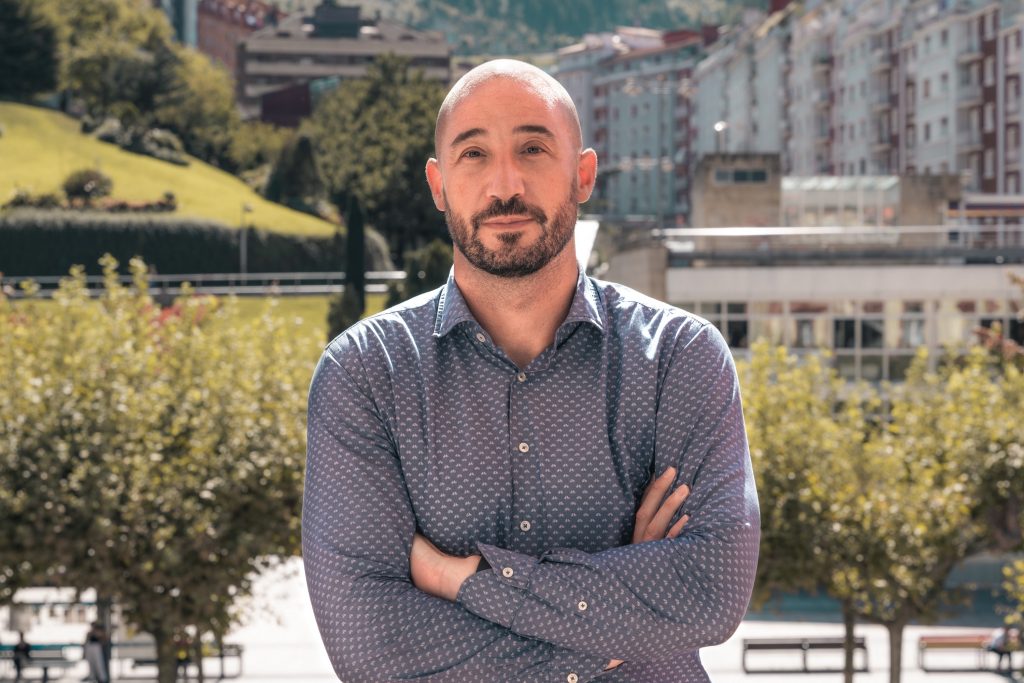
Jon Iraola, alcalde de Eibar

Jon Iraola, mayor of Eibar

The mayor of Eibar, Jon Iraola, knows the Opengela project first hand. Until he took office in March, he was the councillor for Works, Town Planning and the Environment at the Town Council, in charge of managing matters related to urban regeneration in the Txonta neighbourhood, one of the two pilot areas of this European project. He has now added to these responsibilities by becoming the highest authority in the municipality of Gipuzkoa. 

In this interview, he gives his point of view on the progress of Opengela, a European project led by the Basque Government, in which Debegesa (the economic development company of the Debabarrena region, to which Eibar belongs) participates, which implements neighbourhood offices to undertake urban regeneration processes and is financed by the European Commission’s Horizon 2020 programme.   

You have followed the evolution of the Opengela project since it began in May 2019. What does it mean and what value does it have for Eibar? 

The Town Council and the Basque Government started working with the Txonta neighbourhood at the end of 2017, when the Government launched a grant of over 2.3 million euros, which was increased slightly to just over 2.5 million a few months ago. The Town Council is also participating with an additional grant of 400,000 euros to complement the project. 

Urban regeneration was urgently needed. Txonta is a complex neighbourhood from an urbanistic point of view and although there have been attempts in the past, the regeneration of the neighbourhood has not been completed until now. This government grant was a good opportunity to move on to the rehabilitation of the 17 apartment buildings included in the project. Opengela is also an instrument of great potential because it touches on several aspects of regeneration. On the one hand, the office itself, essential to the project, serves to articulate good practices and ways of working that can be extended to other future offices in other cities that want to rehabilitate neighbourhoods. In addition, Opengela brings with it funding, which is essential for the residents of the neighbourhood. The 17 apartment buildings are undertaking rehabilitation of facades, roofs, improving accessibility… These are works of great magnitude and of a very high economic cost. In some cases, they are buildings with few neighbours, so the burden for each neighbour is even greater. The financing offered by Opengela is essential to start the project, as the subsidies are received once the outlay has been made, but in order to be able to do it, it is necessary to have the money, and this is not always the case.  Opengela is a project that still has a lot of development. 

There are many agents involved in the project. What is the role of your Town Council in in this project? 

It has fallen to us to promote the project insofar as we have direct contact with the neighbourhood and we have been in charge of presenting the project to them. It is true that we have gone hand in hand with the Basque Government, but the Txonta office is managed by municipal staff. We have had to do a lot of pedagogical work and in many cases convince the neighbourhood of the goodness and seriousness of the project because at the beginning there was some mistrust about what was going to happen. These are logical mistrusts, insofar as they are ambitious projects, there is a lot of money involved, and it is really difficult to get people involved. We had to organise a lot of meetings and listen to what the neighbours were telling us, what their concerns were, because this also helps us to learn and enriches the project. Often these projects are designed from an abstract point of view, with the best of intentions and always thinking of the good of the neighbours, but in their development, it is necessary to listen to them, detect their real needs, their concerns, and incorporate solutions. Such a project has to meet all these needs and concerns. 

The residents must be convinced of the project, of the works they are going to undertake and that we are going to be there to help and support them. The office has done a very necessary and very important job of listening. 

As you say, the idea of promoting the urban regeneration of Txonta goes back a long way. Do you see that it is finally about to become a reality? 

-It is true that when started in 2018, it was difficult to get started. It took time for all the agents involved in the project to get to know each other and to fit all the pieces together to get the project underway. We had to overcome the mistrust of the neighbours that I mentioned earlier. I think we have achieved this to a large extent. … When planning other similar projects, we will have to take into account how long it has taken to get the Txonta project off the ground. I do not think it is possible to get an idea beforehand. For the future, when setting deadlines for the completion of projects, the experience of the neighbourhood will have to be taken into account. The Town Council and the government have also had to learn things: to listen to the concerns of the residents and to be sufficiently flexible to make the project flow better. In addition, the pandemic has slowed the project down a lot.  

You know the concerns of the residents, what do they tell you, how is the project being received? 

It was difficult for the neighbourhood to have confidence in the project, essentially because of its magnitude, and for them to believe that we were going to deliver everything we offered them. There was a certain, and reasonable, mistrust of the project. In this neighbourhood, things had been tried before and they had not worked out. The residents also demanded a lot of involvement from the institutions, and it was clear to all of us that we had to work together on this. Many concerns had to do with the financing of the works, the deadlines…  

The person who manages the office, Cristina Boyar, and Debegesa –Esther Zarrabeitia- are doing an excellent job. an important part of the success lies in how they are attending to and managing the needs of the residents.  

Do you detect any evolution since that initial mistrust? 

Yes. The projects are moving forward and some apartment buildings are already up and running. In fact, some of them have even finished the works… Almost all the apartment buildings have joined the project. The fact of seeing that the other one has done it is an incentive. There is always a need for somebody to go first. Some communities saw things very clearly, they went ahead with things and the rest have continued along the same path. 

It is true, the rehabilitation work in Txonta can already be seen, although there is still some time to go to see the results and take stock. What would you say to any other municipality interested in applying this model? 

That the neighbourhood office is essential. It has been responsible for building the necessary trust between the institutions and the neighbourhood. The residents have seen that the institutions are accompanying them in this process. Opengela also has a part of financial support, which has come to us a little late because our project was already underway. We are aware that developing the financial instrument to provide this funding is not at all easy and that the Basque Government has worked very hard to achieve it. And now it is finally a reality. There are two very important aspects. In addition to the importance of the neighbourhood office, a mature financing system is needed to help solve the initial liquidity problems involved in these works. An Opengela project with the neighbourhood office, and with a financing system that is already mature, agile, already set up, and that can be set up automatically, would be important aspects.    
Bandera de la Unión Europa

This project has received funding from the European Union’s Horizon 2020 research and innovation programme under grant agreement No 846707.

Otxar Opengela

Address: Avenida Pau Casals, No. 16, Otxarkoaga, Bilbao (In front of Plaza Kepa Enbeita)

Telephone: 946 85 19 32

E-mail: otxaropengela@vvmm.bilbao.eus

Txonta Opengela

Address: Calle Txonta No. 3, ground floor, Eibar

Telephone: 688 77 97 37

E-mail: txontabulegoa@eibar.eus

Copyright@2019 | All rights reserved | Legal notice | Icono de Twitter  Icono de Youtube

Copyright@2019 | All rights reserved | Legal notice Icono de Twitter  Icono de Youtube